Evolutie van twee bakken deze lente/zomer. Die kunnen goed tegen de hitte!


En plots was er de drang om iets te schrijven. Het is niet nagelezen, het is gewoon mijn gedachtenstroom vandaag, op mijn blog. Klinkt het niet, dan botst het, en dat is ook oké!
fertiliteit
Ik kwam daarnet deze video tegen van de Financial Times:
https://www.youtube.com/watch?v=6lFXmDk-tps
Het gaat over de correlatie tussen smartphonegebruik en het aantal kinderen dat geboren wordt. Hun theorie is dat het aantal vrouwen dat kinderen krijgt daalt, omdat ze meer in de smartphone-influencer wereld leven dan dat ze mensen in levende lijve ontmoeten. Ze maken ook direct de stap naar meer zelfmoordgedachten bij hevig smartphonegebruik.
De paper zelf is van april dit jaar en kan je hier vinden (wel 63 bladzijden):
https://homepages.uc.edu/~moscoshn/Personal_webpage/papers/Smartphone_web.pdf
Ik ga ervan uit dat de cijfers kloppen, dat er inderdaad een correlatie is tussen het invoeren van de smartphone in een land, en de problematiek om een partner te vinden om kinderen mee op de wereld te zetten. En het klopt uiteraard dat iemand die verslaafd is aan Instagram/Tiktok/... een ander beeld heeft van 'de gewone mens' dan iemand die nooit naar deze media kijkt. Maar er is meer aan de hand.
veiligheid
Er is veel angst vandaag, meer dan in de jaren 80 toen de criminaliteit veel hoger lag. (Noot: Er zijn nu meer aangiftes van misbruik, maar het gebeurde vroeger wel vaker denk ik.) De media, zowel de klassieke als de sociale media, lijken mensen uitsluitend in emoties te duwen: bang, bedroefd, boos en soms een keer blij. Wees bang voor mannen, voor terrorisme, voor hoge prijzen. Bedroefd voor ongevallen met kindjes. Boos op Poetin en China, en Israel. Cijfers en statistieken tellen niet meer, de anekdotes vol emotie krijgen alle aandacht. Waar in de jaren 80 de krant nog schreef: "Er zijn 700 bedrijven failliet gegaan deze maand, en 900 nieuwe opgericht!" wordt alles na de komma vandaag niet vermeld. Mensen bang maken levert immers meer 'clicks' en 'views' op.
Zie bijvoorbeeld vandaag op VRTNWS over 'Marie' en 'Katrien', ik durf het geeneens te lezen na 'Valerie' enkele dagen geleden. Ik was kapot na dat Valerie-verhaal, zucht. Die journalist had dat wel verdomd goed geschreven, de beste horror kan er niet tegenop!! Dat soort gruwel verhalen voor vrouwen, veroorzaakt door mannen, is de laatste twintig jaar schering en inslag. Alsof het in mannen-genetica zit.
Lezen op eigen risico:
https://www.vrt.be/vrtnws/nl/2026/06/22/getuigenis-stiekem-genomen-naaktbeelden-fora-en-justitie/
Het deed me denken aan het huidige onveiligheidsgevoel dat (vooral jonge?) mensen hebben. Ja er was ook criminilateit en wreedheden en misbruik in de jaren 80, maar we zagen dat maar eenmaal per dag op TV, tijdens het nieuws om 19u30. Als dat al in het nieuws kwam. Vandaag de dag is er minder criminaliteit in België(*), maar al wie vaak op een smartphone kijkt (incluis de vrtnws app), wordt er wel veel meer mee geconfronteerd. De TV had natuurlijk ook dat effect, maar dat was toch veel langzamer, veel gradueler en jarenlang enkel 's avonds in familiale kring. De smartphone is er als je wakker wordt, als je op de WC zit, als je op de bus wacht, als je niet kan slapen, kortom altijd, en zeker al die tijd die je *alleen* doorbrengt.
(*) Ik vind geen goeie cijfers over de evolutie van het aantal misdrijven per jaar sinds de jaren 50-60-70-80 tot nu.
https://www.vrt.be/vrtnws/nl/2023/06/21/studie-nicc-criminaliteit-in-belgie-daalt/
vertrouwen
Toen ik pas mijn rijbewijs had (1989), heb ik honderden lifters meegenomen. Zo goed als altijd tieners, de helft of meer waren meisjes. Zeker in mijn unief periode dat ik vanuit Leuven vrienden afzette in Zoersel, en dus vrijdagavond laat via Sint-Antonius, Westmalle, Oostmalle naar Wechelderzande reed. Ik heb die rit zelden alleen moeten doen, en vaak waren dat leuke gesprekken. Ik had zelf ook jaren gelift, honderden keren meegereden met vreemden, nooit was er enige spanning. Ik heb in vreemde auto's gezeten terwijl de eigenaar een winkel binnen ging, sleutels erop of zelfs met draaiende motor. Dat vertrouwen hadden de volwassenen toen in een onbekende zestienjarige. Logisch dus dat ik een 'pay it forward' mentaliteit had toen ik zelf een rijbewijs had. Gisteren was een vriendin hier heel de dag klimaatvluchteling, die rijdt nog rond met haar auto. Ze zei dat het al twintig jaar geleden was dat ze nog een lifter had meegenomen. Er zijn ook gewoon geen lifters meer.
cancelcultuur
Er zijn uiteraard veel alternatieven zoals Uber/deelwagens/deel-whatever, maar toch. Dat soort vertrouwen in elkaar is weg. Maar dat heeft evenveel te maken met mobiliteit als met de smartphone. Toen wij vroeger 'uit' gingen was dat vaak naar fuiven van 'Union Servet' in Pulderbos/Westmalle/Sint-Antonius. Daar was je dan, op een fuif met een paar honderd mensen, maar ook met je vrienden, je buren, je klasgenoten, de mensen van de harmonie, ... m.a.w. je was in een super veilige omgeving. Je kon als vrouw het 'risico' nemen om met een stoere/stoute man te dansen want je wist dat als die iets te ver ging, dat zowel jouw vrienden als zijn vrienden tussenbeide zouden komen. Je hield elkaar in 't oog, wie gaat met wie buiten, je kende van vele mensen de ouders en wist waar ze woonden. (En die ouders kenden ook uw punten van uw laatste test Frans of wiskunde!)

So there is this post which says:
"Yes, the people who are likely to care are admins with cobwebby
homebrew cronjobs that regularly generate painstakingly formatted
security reports and send them to the fax machine, or whatever."
...I feel extremely personally attacked by this :)
(Replace fax with mail, or whatever.)
I want my freshly upgraded to Debian Trixie Raspberry Pi to keep sending this cobwebby report... even if it is only for a couple of years to come... thus:
install dependencies:
apt install build-essential gettext autoconf flex bison libtool autopoint
get the source:
git clone https://github.com/util-linux/util-linux.git
rtfm:
cd util-linux
more Documentation/howto-compilation.txt
compile:
./autogen.sh && ./configure --disable-all-programs --enable-last
make last
install:
cp ./last /usr/bin/last
ln -s /usr/bin/last /usr/bin/lastb
happiness:
# lastb
btmp begins Thu Dec 4 15:50:47 2025
I stop watching and downvote the moment your video has middle-of-screen subtitles. Idem ditto for huge forced subtitles.
This command on a Raspberry Pi 3:
stty -F /dev/ttyACM0 ispeed 9600 ospeed 9600 raw
Resulted in this error:
stty: /dev/ttyACM0: Inappropriate ioctl for device
This happened after the sd-card (with the OS) of the Pi entered failsafe mode so it is read only. I used dd to copy the 16GB sd-card to a new 128GB one:
dd if=/dev/sdd of=/srv/iso/pi_20250928.isoThe solution was to stop the module, remove the device, and start it again:
# modprobe -r cdc_acm
# rm -rf /dev/ttyACM0
# modprobe cdc_acm
... as it was probably copied with dd from the read-only sd-card.
epilogue: The 16GB SD was ten to fifteen years old. The Pi expanded the new card to 118GB not 128GB as advertised: relevant XKCD https://xkcd.com/394/
Tot zover de nieuwe hobby. Venuskes zijn niet de gemakkelijkste om gelukkig te maken.


Enkele van de Sarracenia zoals ze nu buiten staan. Die eten veel insecten, vooral wespen.


Nieuwe hobby sinds 2021; vleesetende plantjes kweken.
Hier vijf bekertjes die Nepenthes mij geven.


2025 = (20 + 25)²
2025 = 45²
2025 = 1³+2³+3³+4³+5³+6³+7³+8³+9³
2025 = (1+2+3+4+5+6+7+8+9)²
2025 = 1+3+5+7+9+11+...+89
2025 = 9² x 5²
2025 = 40² + 20² + 5²

I was annoyed in the first half by his incessant use of anecdotes to prove that ADD is not genetic. It felt like he had to convince himself, and it read as an excuse for his actions as a father.
He uses clear and obvious examples of how not to raise a child (often with himself as the child or the father) to play on the readers emotion. Most of these examples are not even related to ADD.
But in the end, definitely the second half, it is a good book. Most people will recognize several situations and often it does make one think about life choices and interpretation of actions and emotions.
So for those getting past the disorganization (yes there are parts and chapters in this book, but most of it feels randomly disorganized), the second half of the book is a worthy thought provoking read.
What a disaster this is, the DIY framework laptop.
The box...

...contains more boxes.

The parts are few...

...so the laptop is assembled in less than a minute?!

Unpacking the thing took longer than assembling it!
Reading this webpage took longer than assembling it!
Installing the DDR5 memory took 1 second: click and done.
Installing the nvme took 3 seconds: unscrew one screw, click and screw.
Installing the bezel was far more challenging, took almost 30 seconds! (*)
Attaching the keyboard: about three seconds?
Installing the four modules: 1 second per module (or less?)
I'm not that good at irony, but I was hoping for at least 20 minutes of fun assembling this thing... and only got one minute. :-/
(*) This gave fond memories of assembling tower PC's in the nineties; ISA/PCI slots click, CD-ROM atapi click, hard disk and IDE jumpers easy. But closing the tower case... well that was the hard part!
Installing an OS
The guide says to be patient when booting (powering on) the laptop for the first time, it may take several minutes.
I timed it, it took 57 seconds to get to this screen:

And now there is this; it has been a long time since I saw a default XFCE, Firefox and terminal.


Charlie Mackesy - The boy, the mole, the fox and the horse (2019)
In so far as you can read this book, I read this book. This book allows you to read one page, and then ponder on it for a week. It's a story, but it is also not a story but more a psychological insight into humans. I will probably open this book again several times this year to discover even more about the meaning of a single page.
Brian W. Kernighan - Understanding the digital world (2021)
Kernighan is famous for co-authoring "The C programming Language" with Dennis Ritchie in 1978 and I have always looked up to him.
In this book he gives an excellent overview of computers and networks, including an easy to read introduction to programming, cryptography and (digital) privacy. I would not advice this book for IT-nerds, since it is way too simple. It is though as good an overview as is possible in 260 pages.
David Kushner - Masters of Doom (2003)
Well this was an excellent read! Enjoyable, intriguing, educational and probably only for fans of Doom or of John Carmack.
The book tells the story of the two John's that created the DooM game in the early nineties. David Kushner interviewed a lot of people to get a complete picture of their youth, their first meeting, the development of Commander Keen, Wolfenstein 3D and of course DooM, and also many games after that like Quake and Heretic.
This book is a nice combo with Sid Meier's Memoir.

The story of the creation of the civilization series of games is a really good read, though probably only if you lived in this era and played some of the early Civilization games. Or earlier 'versions' like Empire or Empire Deluxe, which are mentioned in this book for serving as inspiration for the first Civilization game.
I like the 4X turn-based system of gaming, too bad there are almost no other good games using this (Chess comes close though).
It took a while, but here are three books I've read.
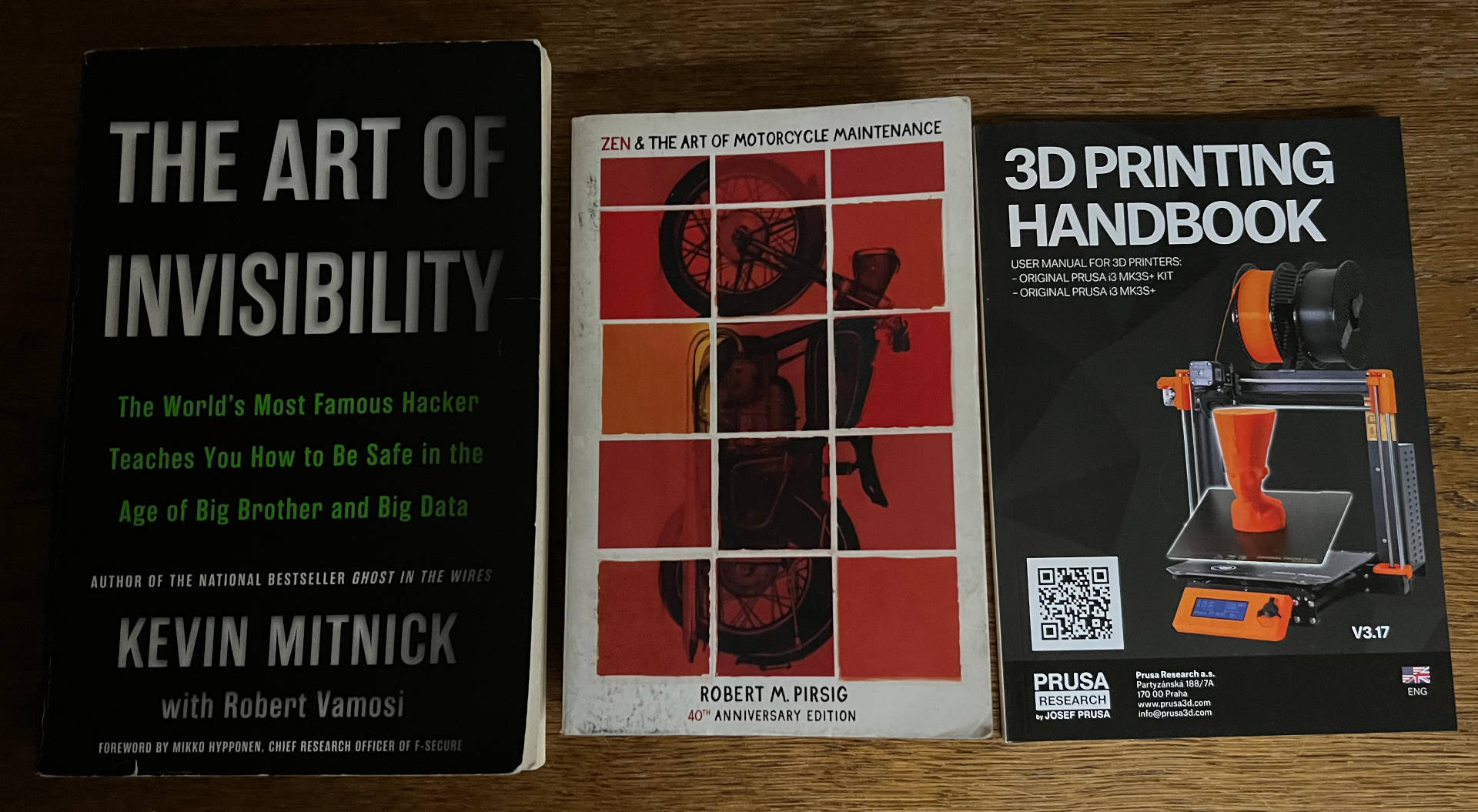
Kevin Mitnick - The Art of Invisibility (2017)
I have been interested in Kevin Mitnick since his 1980ies hacking. He is mentioned in several books that I read in the past.
This book is about all the personal data one leaves behind when using the internet (or devices connected to the internet). It is a rather simple guide on how to increase your privacy or how to aim to become almost invisible on the internet.
I would not advice this book for nerds, or for IT security experts, the book is probably not aimed for those people anyway. People who know close to nothing about computers/networks could benefit from this guide.
Robert M. Pirsig - Zen and the art of motorcycle maintenance (1974)
Now this is an interesting read. It is not about motorcycles, in fact it is perfectly fine if you replace the word motorcycle by 'smartphone' or 'computer' or 'internet privacy and tracking' in the first half of the book. There are some very insightful comments about how people react in different ways to technology.
The main part of this book though, is not the motorcycle trip with his son through the United States, but his alter ego named Phaedrus. The writer was diagnosed with catatonic schizophrenia and received electric-shock treatment. In the book he remembers fragments of this Phaedrus personality (with an IQ of 170).
The second half is a tough read. I often needed to reread several sentences to grasp what he was saying. (Which was never the case in the Mitnick book above.)
Prusa 3D printing handbook
I finally bought a 3D printer and would advice this to anyone who has lot's of time. Yes, this is not yet ready for end users that only want a 'File - Print' option on the computer. But a whole new world opens, at least for me it's a new world with many possibilities and adventures.
It's a small booklet, but I mention it anyway because it is really good, as are all the follow-up guides on prusa3d.com.
An alphabetical list of software that I really like.
Apache: Not as popular as it used to be, but I know it and so still use it
apt/aptitude/apt-get: The origin of all 'apps' and the most user friendly and secure way to manage software
Audacity: Or is that too controversial now with their telemetry?
bash: The best interface to my computers
convert: From Imagemagick, for batch converting images
Civilization IV: Yes 4, the only software that is not (yet?) open source
cron: It wakes me up every day (using mpv and bash)
Debian: I run it on almost everything
ffmpeg: to convert video formats
find: because I tend to forget where I put stuff :)
Firefox: because an alternative browser is crucial
FreeCAD: Amazing CAD software, and I like math
gcc: Because coding in C is fun!
gimp: Easy image manipulation
git: How did I ever live without it?
gramps: To keep track of my ancestors
grep: Often very useful.
Homebrew: To make a MacBook usable
Inkscape: Because vector graphics are essential
Linux: in background of course, like so many other tools that I am rarely aware of
make: For software that is not part of Debian
mariadb(mysql): So easy to build a database
mpv: For audio and video (and for their API)
Openshot: To create Lego NXT or Prusa video's
PrusaSlicer: A 3D printer opens a whole new world of possibilities
Python: I hate this language, but it is used so much and coding is still fun
return Youtube dislike: How else is Youtube usable?!
rsync: For backups
Singlefile: because web pages tend to disappear forever
ssh: Multitool for anything remote
Thunderbird: Reading my mail since 1996 (as Netscape Mail)
tmux: used daily, configured to a quiet and relaxing layout
Video downloadhelper: because video's tend to disappear forever
vim: By far the best editor for text, code, config files and more.
wine: To play that one game on Debian (though I wish its 32-bit had as much memory as 32-bit Windows XP)
Wireshark: The best tool to learn about networking
XFCE: My GUI since almost 20 years
xfce-screenshooter: Because screenshots are useful
Why did I not know about this until now?
https://github.com/tmux-plugins/tmux-resurrect
It restores all windows, all panes, all ssh sessions.
Door omstandigheden wat minder kunnen lezen, maar bij deze nog eens drie boeken:

De Hel van Deurne-Noord is een verzamling getuigenissen van voetballers en trainers, en reporters, over hun ervaring op den Bosuil. Het dateert van 2016 ofzo denk ik, dus het is vooral dromen van een groot Royal Antwerp FC. Ik denk niet dat er toen iemand was die Naingolan of Alderweireld als spelers van den Antwerp zag.
Het boek leest zeer vlot, elke getuigenis is maar een blad of twee, soms drie. Ideaal voor bus en treinritten.
Ons Antwerpen heeft me blij verrast! Dit is een van de beste boeken dat ik al gelezen heb. Het dateert van rond 1931, de auteurs zijn dus al lang dood, anders had ik hen zeker bedankt.
In dit boek wandel je rond in het Antwerpen van 90 jaar geleden. Er wordt bijvoorbeeld gezegd dat er plannen zijn om een Rubenshuis te maken in de buurt van de Meir/Wapperstraat. Het plein dat nu 'Wapper' heet, bestond nog niet. Er is ook geen Astridplein (dat heette toen Statieplein), maar ze hadden wel net meer dan tienduizend schepen gehad in Antwerpen op 1 jaar tijd.
Ik ben zinnens eens met dit boek rond te lopen, want echt elke straat waar ze zijn wordt vermeld, tot huisnummers toe. De weg zou dus helemaal moeten te volgen zijn.
Starten met C is mijn introductie tot programmeren in C (ik kende totdantoe enkel Basic, Assembler en PASCAL, ah en COBOL). Dit was ons cursusboekje in Leuven in 1991 denk ik... en maakte mij een grote fan van C.
Ik ben het terug aan het lezen nu en beleef er weer veel plezier aan. Nog steeds fan van C dus, helaas ben ik momenteel niet zo'n goeie programmeur. Nu het bijna uit is, zal ik mijn odio applicatie maar snel aanpassen, voordat iemand deze klucht kan zien :)
Setup of a HifiBerry AMP2...on a Rapsberry Pi 2.
First attempt was with Volumio, as advised by a friend. Well that works, but I personally find the interface a horror, and I seem to lose control of the Pi since Volumio is a full OS that seems only accessible by web interface. No thanks.
Using Raspberry Pi OS:
- download Raspberry Pi OS lite (command line is fine)
- extract the image
- dd the image to the sd-card
dd if=/home/paul/2022-04-04-raspios-bullseye-armhf-lite.img of=/dev/sdb bs=1M
- mount it to enable ssh
touch /boot/ssh
- I also had to set a password for the pi user, since 'raspberry' was not accepted?
- Boot the Pi (the HifiBerry is still attached)
- ssh into the Pi
apt update
apt upgrade
apt install vim
vi /boot/config.txt
#dtparam=audio=on
#dtoverlay=vc4-kms-v3d
# added by paul 2022-07-29 for HifiBerry AMP2
dtoverlay=hifiberry-dacplus
force_eeprom_read=0
Comment out the first two lines, add the last two. Check here for other HifiBerries.
Now, before using mplayer or something, LOWER THE VOLUME! Use a really low value, and gradually go up while playing music since the default is extremely loud.
amixer -c 0 sset Digital "20%"
Thanks for listening :)
Zeker doen als je interesse hebt in ruimtevaart, er staan enkele boeiende objecten op ware grootte en dat geeft toch een andere indruk. De geschiedenis van de ruimtevaart wordt er goed in beeld gebracht, helaas gaat de rest van de XPO enkel over de Verenigde Staten, Rusland en een beetje ESA. Geen woord over de Indische, Japanse of Chinese ruimtevaart van de laatste tien-twintig jaren.
Er staat ook een foute schaal bij een Saturn V (1:144 ipv 1:72) en ze geven een nieuwe betekenis voor een 'dag' (op Aarde is een dag 24u, volgens XPO is een dag op de maan 14 Aardse dagen, maar dat moet 28 zijn gezien de nacht ook een integraal deel is van de dag).
Het Maagdenhuis is enerzijds een standaard museum met schilderijen (ze hebben Pieter Paul Rubens, Jacob Jordaens en Antoon van Dyck!) en oude voorwerpen, anderzijds geeft dit museum duidelijk aan hoe de tijdsgeest kan veranderen.
Hier staat ook de houten Clara (helaas bestaat het restaurant met dezelfde naam niet meer).
Mayer van den Bergh is wereldberoemd voor al wie 'de Dulle Griet' van Suske en Wiske heeft gelezen. Het schilderij met dezelfde naam van Pieter Breugel is gerestaureerd sinds ik het de laatste keer zag, en ja, het ziet er geweldig uit vandaag.
Behalve de schilderijen en de (soms heel oude) voorwerpen, vind ik hier ook de kamers zelf al de moeite om te bekijken.
Voluit het Snijders&Rockoxhuis is boeiend als je graag oude schilderijen ziet. Je krijgt hier een ipad om informatie te lezen over alles wat er staat (of hangt), en dat vind ik veel beter dan een audioplayer omdat ik veel liever lees dan luister (of kijk).
Hier hangt het beroemde spreekwoorden schilderij van Pieter Breugel. Er staat nu een touchscreen bij dit schilderij dat alle spreuken verraadt... maar misschien is het leuker om er zelf een paar te ontdekken die vandaag nog gangbaar zijn.


